Normal Brakes May Still Work
In many cases, your regular hydraulic brakes may still operate, but the anti-lock function may be disabled until the fault is repaired.
Call Us:
615-946-2079 

ABS diagnosis, wheel speed sensor testing, hub assembly inspection, and brake system repair for drivers in Bethpage, Gallatin, Portland, Castalian Springs, and nearby Tennessee communities.
Your anti-lock braking system helps keep the wheels from locking during hard braking, giving you a better chance of maintaining steering control during emergency stops.
When the ABS light comes on, it should not be ignored. Around Middle Tennessee, worn wheel bearings, hub assemblies, damaged tone rings, and rough-road wear can all contribute to ABS warning lights and brake system problems.
Brake System Diagnostics
ABS is part of a complete braking system. It depends on hydraulic brakes, wheel speed sensors, tone rings, hub assemblies, wiring, control modules, and communication between vehicle systems.

The anti-lock braking system, usually called ABS, is designed to help prevent wheel lockup during hard braking. When a wheel locks, the tire can slide across the road instead of gripping it. That can reduce steering control and make a bad situation worse.
ABS helps by monitoring wheel speed. If the system sees that a wheel is slowing too quickly compared with the others, it can rapidly adjust brake pressure to that wheel. This helps the tire keep rotating and gives the driver a better chance of steering while braking hard.
For drivers in Tennessee, this matters even more. Many local roads are hilly, winding, uneven, and rough. Some roads began as old rural routes long before modern traffic demands. That kind of driving environment is hard on suspension parts, wheel bearings, hub assemblies, and brake components.
Early automobiles used mechanical brake systems with rods, cables, and levers. As cars became faster and heavier, hydraulic brakes gave drivers stronger and more even braking force. Later, power brake boosters made it easier to apply enough braking force during panic stops.
Those improvements made vehicles easier to stop, but they also revealed another problem. In emergency braking, drivers could still over-brake and lock the wheels. Brake proportioning valves and pressure-limiting devices helped balance braking between the front and rear wheels, but they could not manage each wheel individually.
Anti-lock braking systems were developed to solve that problem. By monitoring wheel speed and adjusting brake pressure, ABS made it possible for a vehicle to respond to wheel lockup conditions more precisely than older mechanical or hydraulic-only systems.
Modern electronic four-wheel ABS became a major production milestone when Mercedes-Benz and Bosch introduced ABS on the S-Class at the end of the 1970s. From there, ABS became more common and eventually became part of the foundation for traction control and electronic stability control systems.
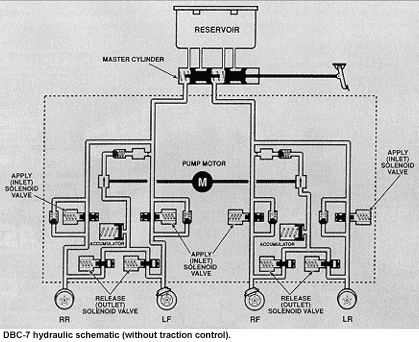
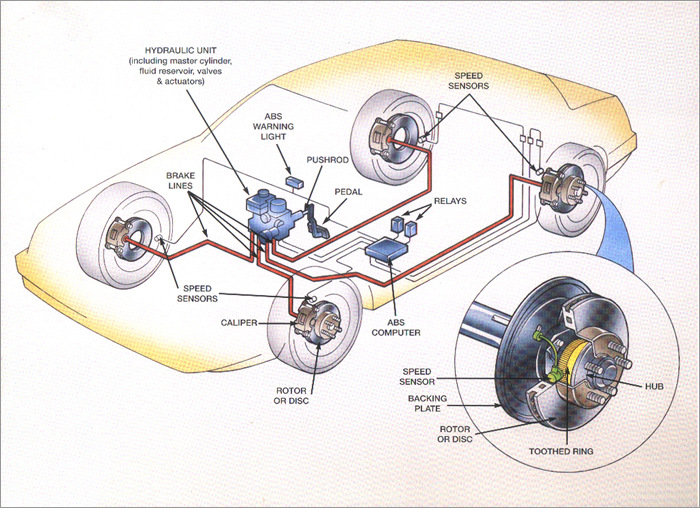
ABS uses wheel speed sensors to monitor each wheel. If the control module sees that one wheel is about to lock, it commands the hydraulic control unit to reduce and reapply brake pressure. This can happen many times per second.
When ABS is working during a hard stop, the brake pedal may pulse or vibrate. That sensation can feel strange, but it can be normal when the system is actively controlling brake pressure. The driver should continue applying steady pressure instead of pumping the pedal.
An ABS system depends on several parts working together. A failure in any one area can trigger warning lights or disable anti-lock braking.
Many modern vehicles combine the wheel bearing, hub assembly, tone ring, and wheel speed sensor area into a closely related system. That means a worn wheel bearing is not always just a noise problem. It can also become an ABS problem.
When a bearing wears, it can create movement, vibration, heat, or uneven sensor readings. If the wheel speed sensor cannot read the tone ring correctly, the ABS module may see a signal that does not match the other wheels. That can turn on the ABS warning light or affect traction control and stability control systems.
In our area, wheel bearings and hub assemblies work hard. The hills, valleys, curves, potholes, gravel roads, and uneven road surfaces around Middle Tennessee can punish hub assemblies and suspension components. That is why a driver with a growling wheel bearing noise and an ABS light may be dealing with one connected problem, not two unrelated problems.
If you hear a humming, growling, or roaring noise from a wheel and the ABS light is also on, it is worth having the hub assembly and ABS sensor data inspected together.
Tone rings, sometimes called reluctor rings, are toothed or magnetic rings that rotate with the wheel or hub assembly. The wheel speed sensor reads the tone ring to determine wheel speed.
If a tone ring becomes cracked, rusted, damaged, misaligned, or contaminated with metal debris, the sensor signal can become inaccurate. This can create ABS warning lights, traction control lights, or intermittent brake system complaints.
Modern vehicles use Controller Area Network communication, commonly called CAN, so modules can share information. The ABS module may communicate with the engine computer, transmission module, body control module, traction control system, and stability control system.
That matters because an ABS complaint is not always limited to one sensor or one hydraulic part. A communication problem, power supply issue, ground problem, or module fault can affect more than one warning light at the same time.
Common ABS problems include wheel speed sensor failures, damaged wiring, corroded connectors, worn hub assemblies, damaged tone rings, hydraulic control unit faults, control module issues, low brake fluid, and conventional brake problems.
Drivers may notice an ABS warning light, traction control warning light, stability control warning, unusual brake pedal feel, or the loss of anti-lock braking function. On some vehicles, several warning lights can appear together because the systems share wheel speed information.
Many drivers ignore an ABS light because the vehicle still stops during normal driving. The problem is that ordinary stopping is not the only thing ABS is designed for. ABS is there for panic stops, wet roads, loose gravel, steep hills, and emergency situations where wheel lockup can cause loss of control.
That is especially important here in Tennessee. A driver coming down a hill, entering a curve, hitting a wet patch, or braking on rough pavement needs the braking system to do everything it was designed to do.
ABS repair should not be handled by guessing. A scan tool may show a trouble code, but that code still has to be tested. For example, a wheel speed sensor code could be caused by the sensor, damaged wiring, a corroded connector, a worn bearing, a damaged tone ring, or a poor signal path to the module.
At Rock Bridge Automotive Repair, we diagnose the system before recommending repairs. That means checking the warning light, scanning the system, inspecting wiring and connectors, checking related brake and hub components, and confirming the failure before replacing parts.
Anti-lock braking is one part of modern brake technology. Many vehicles also use traction control and electronic stability control systems that depend on ABS information. Hybrid and electric vehicles may also use regenerative braking, while heavy-duty trucks may use air brake systems instead of standard hydraulic brakes.
To learn more about those systems, visit our advanced braking systems page.
These references support the technical and historical background used on this page.
ABS Warning Light
In many cases, your regular hydraulic brakes may still operate, but the anti-lock function may be disabled until the fault is repaired.
Wheel bearings and hub assemblies can affect wheel speed sensor readings, especially when wear creates movement or signal problems.
Cracked, rusted, dirty, or damaged tone rings can cause inaccurate wheel speed data and trigger ABS or traction control warning lights.
Accurate testing helps prevent unnecessary replacement of expensive ABS modules, sensors, or hub assemblies.
ABS Questions and Answers
The ABS light means the vehicle has detected a problem in the anti-lock braking system. The regular brakes may still work, but anti-lock braking may not operate correctly during a hard stop.
Yes. On many vehicles, the wheel speed sensor and tone ring are closely tied to the hub and bearing assembly. Bearing wear, hub movement, or tone ring damage can cause incorrect wheel speed readings.
Yes. Many traction control and stability control systems rely on ABS wheel speed sensor data. A fault in the ABS system can trigger traction control or stability control warning lights.
During a hard stop, ABS can create rapid pulsing or vibration in the brake pedal. That can be normal when ABS is actively controlling brake pressure.
No. The vehicle may still stop during ordinary braking, but ABS may not work correctly in an emergency stop or slippery-road situation. The system should be inspected.
ABS combines electronics, sensors, hydraulic parts, wheel bearings, tone rings, wiring, and control modules. Proper testing is the best way to find the actual cause instead of replacing parts by guesswork.
Community Discount
We proudly offer a 10% discount to active-duty military members, veterans, and nurses as a thank-you for your service and sacrifice.
Learn About Our DiscountLocal ABS Repair
We provide ABS diagnosis and brake repair for drivers in Bethpage, Gallatin, Portland, Castalian Springs, Westmoreland, and throughout Sumner County, Tennessee.
Brands We Service















© Copyright 2026, Rock Bridge Automotive Repair | Honoring America’s 250th Anniversary