Cooling System Repairs
Learn about the complete engine cooling system and how its parts work together.
Cooling System Repairs
Call Us:
615-946-2079 

Automotive Thermal Management
The word “cooling” can be a little misleading. A good automotive cooling system does not simply make parts cold. It helps keep the engine and related fluids in the correct operating temperature range.
Engine coolant, engine oil, automatic transmission fluid, power steering fluid, manual transmission fluid, and differential oil all work best within the right temperature window. Too hot is a problem. Too cold can also be a problem.
Internal combustion engines create tremendous heat. Fuel burns in the cylinders, metal parts expand, oil temperature rises, and the engine must stay within a controlled range to operate correctly. Without temperature control, engine oil can break down, pistons can expand too much, cylinder heads can warp, gaskets can fail, and the engine can be permanently damaged.
Modern engines are built with tighter tolerances than older engines. Aluminum cylinder heads, lightweight blocks, turbochargers, variable valve timing systems, emissions equipment, and computer-controlled fuel systems all depend on stable operating temperature. That is why we think of the cooling system as part of the vehicle’s complete thermal management system. The job is not only to remove heat. The job is to control temperature.
Early automobiles borrowed ideas from stationary engines, farm equipment, and industrial machinery. Some engines used simple open cooling systems. Others used water jackets around the cylinders and primitive radiators to move heat away from the engine.
Many early systems were not pressurized. Some relied on natural circulation, often called thermosiphon circulation. Hot water rises and cooler water sinks, so the system could move coolant without a modern water pump. These systems were simple, but they had limits. They were slow to respond, they had limited heat capacity, and they were not ideal as engines became more powerful.
Early radiators were often copper and brass. Mechanical fans helped pull air through the radiator. As vehicles became faster, heavier, and more powerful, cooling systems needed better coolant flow, better airflow, pressure control, and better temperature regulation.
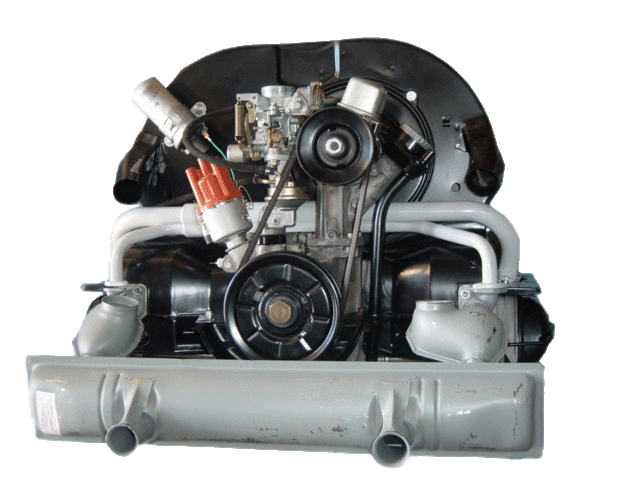 Not every engine used liquid coolant. Air-cooled engines use airflow over cooling fins to remove heat. Air-cooled engines were used in motorcycles, aircraft, Volkswagens, Corvairs, Porsches, small engines, and many industrial applications.
One thing that almost all air cooled engines had in common is that they used oil coolers to help the engine cool. Even the very first design of this engine had an oil cooler as part of the design. Many people even claim that the vw engine was oil cooled, but that is not the case. Still, these engines would never have been as reliable as they were without the use of the oil cooler.
Air cooling eliminates coolant leaks, radiators, hoses, water pumps, and freeze protection concerns. It can also be simple and durable when designed correctly. Air cooling also has limits. Air does not remove heat as evenly as a well-designed liquid cooling system, and air-cooled engines depend heavily on airflow, ducting, fan design, and outside temperature.
As emissions rules, fuel economy goals, passenger comfort, and power output demands increased, most passenger vehicles moved toward liquid cooling because liquid-cooled engines are easier to keep within a controlled temperature range.
Early water-cooled engines used water because water is cheap, available, and excellent at transferring heat. Plain water actually transfers heat better than many antifreeze mixtures. That statement surprises many people, but it is important. Water is very good at absorbing and carrying heat.
The problem is that regular street vehicles need more than heat transfer. They need freeze protection, boiling protection, corrosion protection, water pump seal lubrication, cavitation protection, and compatibility with aluminum, iron, copper, brass, plastic, rubber, and gasket materials.
Plain water has several problems in a street vehicle cooling system:
Engine coolant is a compromise. It may not transfer heat quite as efficiently as plain water, but it protects the system in ways water cannot. That is why the correct coolant matters.
You can learn more about coolant chemistry, mixing coolant types, antifreeze protection, and coolant service on our Engine Coolant and Antifreeze Service page.
Water has excellent heat transfer ability, but water alone is not enough for long-term use in most vehicles. Wetting agents, sometimes called “water wetter” products, are designed to reduce surface tension so water can contact metal surfaces more effectively.
In racing or special-use environments, where freezing protection may not be needed and corrosion control is handled carefully, water and wetting agents can be useful. Street vehicles are different. A daily driven vehicle needs protection through winter, summer, traffic, towing, long idle periods, and years of service.
Pressurized cooling systems were a major advancement. When cooling system pressure increases, the boiling point of the coolant mixture rises. That allows the engine to operate safely at temperatures that would have caused earlier non-pressurized systems to boil.
Radiator caps and pressure caps are not just lids. They control pressure, allow coolant expansion, and help coolant move between the radiator and recovery tank or pressurized reservoir. A weak pressure cap can cause overheating, coolant loss, boil-over, or repeated coolant recovery problems. You can learn more on our Radiator Pressure Cap Diagnosis page.
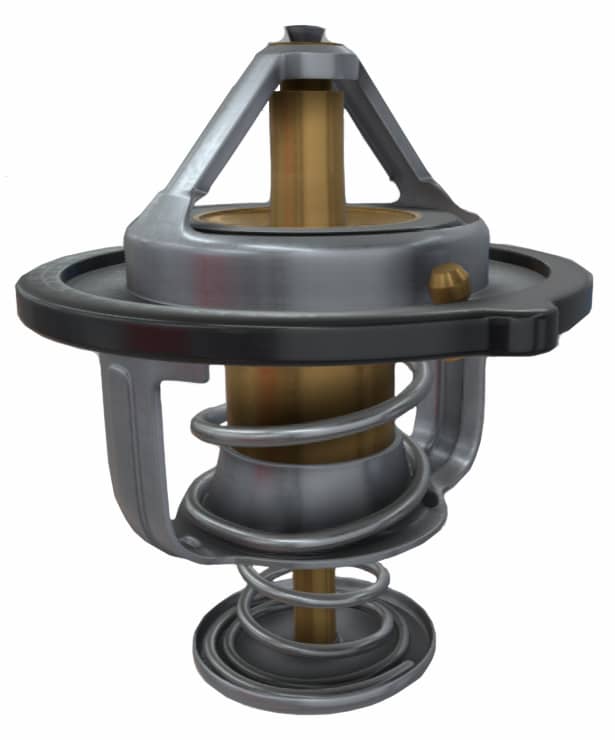 A thermostat helps the engine warm up and then regulates coolant flow once the engine reaches operating temperature. Water pumps circulate coolant through the engine, radiator, heater core, and other cooling system circuits. Radiators transfer heat from coolant to outside air. Heater cores use engine heat to warm the passenger compartment and defrost the windshield.
Many people don't know that almost every air cooled engine ever made also had a themostat. They do the exact same job in an air cooled engine but they also help to aim the cooling fan generated air to specific spots on the cylinder heads and cooling fins. (They also look nothing like this).
You can learn more on our Thermostat Replacement page, Water Pump Replacement page, Radiator Repair page, Radiator Replacement page, and Heater Core Repair page.
Engine oil does more than lubricate. It carries heat away from bearings, pistons, camshafts, timing chains, turbochargers, and other moving parts. As engines became more powerful, more compact, and more heavily loaded, oil temperature became more important.
Engine oil coolers help control oil temperature in vehicles used for towing, high-performance driving, turbocharged operation, diesel work, police service, fleet use, and heavy-duty driving. Oil works best within a proper temperature range. If oil is too cold, it may not flow correctly or evaporate moisture and fuel contamination effectively. If oil is too hot, it can thin out, oxidize, break down, and lose its ability to protect internal engine parts.
Automatic transmission fluid is a hydraulic fluid, a lubricant, and a cooling fluid. It transmits force, applies clutches, lubricates gears and bearings, and carries heat away from the transmission.
Automatic transmissions create heat through torque converters, clutches, gears, hydraulic pressure, and load. Towing, hills, stop-and-go driving, slipping clutches, and heavy throttle operation all increase transmission temperature.
Transmission fluid is also temperature sensitive. It expands as it warms, and it works best within the right operating temperature range. Too cold can affect shift feel and hydraulic operation. Too hot can damage seals, clutches, electronics, and fluid life.
That is one reason many automatic transmission coolers are tied into the radiator or another coolant-based heat exchanger. In cold weather, the engine coolant can help warm the transmission fluid. In hot conditions, the heat exchanger helps control the fluid temperature.
Power steering fluid also works best within a proper temperature range. Steering systems create heat as the pump builds pressure and fluid moves through the steering gear, rack, hoses, and valves. Heavy steering loads, large tires, towing, off-road use, repeated low-speed steering, and hydroboost brake systems can increase power steering fluid temperature.
Like automatic transmission fluid, power steering fluid expands as it warms. Fluid expansion and temperature control matter because fluid level, pressure, viscosity, seal life, and pump performance are all affected by temperature.
Power steering coolers were often simple loops of tubing mounted in front of the radiator. Later designs may use compact coolers, cooler sections integrated into other front-end heat exchangers, or cooling passages built into larger assemblies.
Vehicle manufacturers have limited space at the front of the vehicle. The radiator, A/C condenser, intercooler, transmission cooler, oil cooler, power steering cooler, fan shroud, grille, bumper structure, and active grille shutters may all compete for the same airflow.
That is why many vehicles began combining heat exchangers or packaging coolers together. Transmission coolers were often built into radiators. Some later vehicles placed transmission cooler or power steering cooler sections near or inside condenser assemblies where airflow is strong.
This packaging saves space and helps manage airflow through the cooling stack. It can also help fluids reach the correct operating temperature faster in cold weather when the cooler is tied into a coolant-based heat exchanger.
Automatic transmission fluid and power steering fluid expand as they warm. That expansion is one reason fluid level checks often depend on fluid temperature. A fluid level that looks correct cold may not be correct hot, and a fluid level that looks wrong cold may change after the vehicle reaches operating temperature.
These fluids are designed to operate in a temperature range. When they are too cold, they may be thicker and may not flow or respond as intended. When they are too hot, they may thin out, oxidize, foam, damage seals, or lose protection.
Modern thermal management systems are designed around that reality. Sometimes the goal is to cool a fluid. Sometimes the goal is to warm it. The real goal is to keep it in the correct range.
Active grille shutters are another example of modern temperature control. When closed, they can reduce airflow through the front of the vehicle, helping the engine and fluids warm up faster while improving aerodynamics. When cooling is needed, the shutters open to allow more air through the cooling stack.
Grille shutters are used for more than fuel economy. They are part of a larger strategy to manage engine temperature, transmission temperature, aerodynamic drag, warm-up time, and airflow through the radiator and condenser.
Many high-performance vehicles, heavy-duty vehicles, tow vehicles, and track-focused vehicles use coolers for components that older passenger cars did not usually cool separately.
Manual transmissions, transfer cases, and differentials can generate a great deal of heat under heavy load. Hard acceleration, towing, high-speed driving, racing, off-road use, and steep grades can all raise lubricant temperature.
Differential and manual transmission coolers help protect gear oil, bearings, synchronizers, clutches, limited-slip units, and seals. This is especially important in performance vehicles that are expected to operate at high power levels for extended periods.
Turbochargers add another layer to automotive thermal management. A turbocharger is driven by hot exhaust gas, and many turbochargers use engine oil and coolant to control bearing and housing temperature.
Turbocharged engines also use intercoolers or charge air coolers. Compressing air heats it. Intercoolers remove heat from the compressed intake air before it enters the engine. Cooler intake air can improve power, reduce detonation risk, and help the engine operate more consistently.
Hybrid and electric vehicles made thermal management even more important. These vehicles may need to control temperature for batteries, inverters, electric motors, onboard chargers, power electronics, cabin heat pumps, and traditional engine cooling systems.
Some systems use separate coolant loops. Others use valves, pumps, heat exchangers, chillers, and electronic controls to move heat where it is needed or remove heat where it is not.
Cooling system problems should be diagnosed carefully. An overheating vehicle may have a coolant leak, low coolant, trapped air, a weak pressure cap, a restricted radiator, a stuck thermostat, a failed water pump, an inoperative cooling fan, a blown head gasket, or a control-system problem.
Replacing parts without understanding the system can waste money and fail to fix the real problem. You can learn more on our Overheating Diagnosis page and our Coolant Leak Repair page.
Modern cooling systems use many different materials: aluminum, cast iron, plastic, rubber, copper, brass, steel, gaskets, seals, sensors, and electronic controls. The wrong coolant, mixed coolant, neglected coolant, air pockets, or pressure problems can damage parts over time.
Proper cooling system service is not just draining and filling a radiator. It includes knowing the correct coolant type, checking pressure, inspecting hoses, verifying fan operation, checking temperature data, looking for leaks, and understanding the system as a whole.
Cooling System Information
This page is the educational hub for the cooling system section. The links below lead to more detailed pages about specific cooling system problems and components.
Learn about the complete engine cooling system and how its parts work together.
Cooling System RepairsOverheating can be caused by leaks, airflow problems, thermostat issues, water pump failures, fan problems, or pressure loss.
Overheating DiagnosisCoolant leaks can come from hoses, radiators, water pumps, heater cores, gaskets, caps, or hidden internal leaks.
Coolant Leak RepairModern coolant protects against freezing, boiling, corrosion, cavitation, and material damage.
Coolant ServiceRadiators transfer heat from coolant to outside air and can fail from leaks, clogging, corrosion, or airflow damage.
Radiator RepairSome radiators cannot be repaired safely and must be replaced to restore proper heat transfer and pressure control.
Radiator ReplacementA weak pressure cap can cause boiling, coolant loss, overheating, and recovery tank problems.
Pressure Cap DiagnosisThermostats help engines warm up and maintain proper operating temperature.
Thermostat ReplacementWater pumps circulate coolant through the engine, radiator, heater core, and other cooling circuits.
Water Pump ReplacementThe heater core provides cabin heat and windshield defrosting by using heat from engine coolant.
Heater Core RepairsCooling System Questions and Answers
Engines create tremendous heat during combustion. Cooling systems control engine temperature so oil, metal parts, gaskets, and electronic controls can operate correctly.
Plain water transfers heat very well, but it can freeze, boil, corrode parts, leave mineral deposits, and lacks the additives modern cooling systems require.
Plain water can transfer heat better than many antifreeze mixtures, but coolant protects the system from freezing, boiling, corrosion, cavitation, and material damage.
Transmission fluid and power steering fluid work best in the correct temperature range. Coolers help manage heat during towing, heavy loads, stop-and-go driving, and high-performance use.
Radiators and condensers sit in strong airflow. Some heat exchangers also help warm fluids in cold weather so the fluid reaches the proper operating range faster.
Active grille shutters help control airflow through the front of the vehicle. They can help the engine and fluids warm up faster, improve aerodynamics, and open when additional cooling is needed.
Overheating can be caused by many different problems. Proper diagnosis helps avoid replacing parts that do not fix the actual cause.
Community Discount
We proudly offer a 10% discount to active-duty military members, veterans, and nurses as a thank-you for your service and sacrifice.
Learn About Our DiscountCooling System Knowledge
Rock Bridge Automotive Repair helps drivers understand and repair cooling system problems, overheating concerns, coolant leaks, radiator issues, water pump failures, thermostat problems, and modern vehicle thermal management systems.
Brands We Service











© Copyright 2026, Rock Bridge Automotive Repair | Honoring America’s 250th Anniversary